Escort cards vs. place cards: what to write and how to print
Updated:
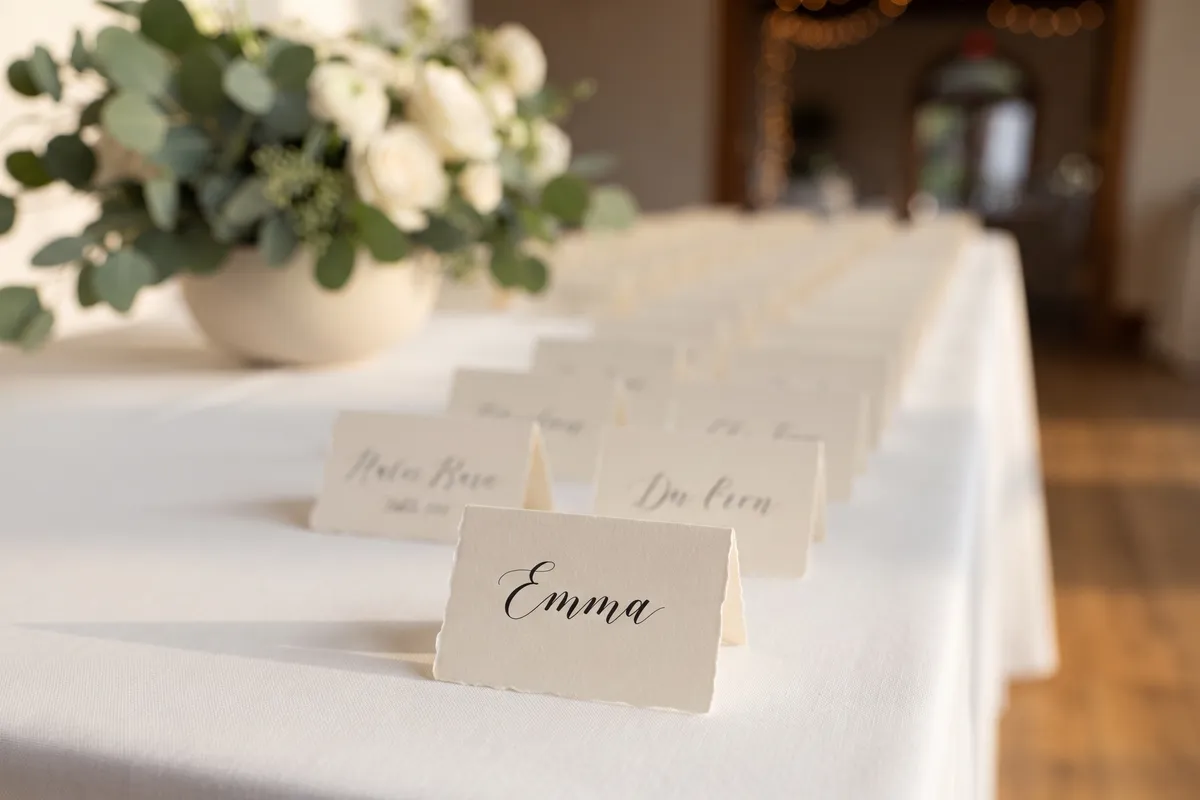
Escort cards tell guests which table they’re at; they sit alphabetically on a table near the entrance. Place cards sit at each seat and show exactly where someone sits. If you only assign tables, escort cards or a seating chart are enough; if you assign seats, you need place cards too. Allergies never go on a visible card; they belong on the catering list.
Escort cards and place cards look like small details, but on the day they answer a lot of questions. Guests who find their name sit down without hesitating, and servers see at a glance who sits where. For that, the cards need to say the right thing, and they need to stand up straight.
Escort cards, place cards or table cards?
| Card | Where it goes | What’s on it | When you need it |
|---|---|---|---|
| Escort card | on a table near the entrance, alphabetical | name and table | whenever you assign tables, instead of or next to a seating chart |
| Place card | at each seat | name, often with table | when you assign specific seats |
| Table card | in the middle of each table | table number or name | as soon as there’s more than one table |
- Escort cards come one per guest, or one per couple. Guests pick up their card and find their table.
- Place cards are only needed for assigned seats. They also help servers with plated meals.
- Table cards can show who sits at that table on the back, if you like.
For escort cards, use the planner’s name badges (Event Pass) with the table shown: they’re printed alphabetically, six per US Letter sheet at 4 × 3 in, ready to cut. Folded place cards with name and table work as well; they’re printed by table, so sort them alphabetically after cutting. Which output suits which job is covered in seating chart, guest list and place cards.
How to address the cards
| Case | What the card says |
|---|---|
| Guest | “Anna Miller”, the name people know her by |
| Couple, escort card | one card “Anna and Ben Miller” is fine |
| Couple, place cards | two cards: “Anna Miller” and “Ben Miller” |
| Plus-one with no name yet | “Guest of Anna Miller” |
| Child | a card of their own with their first name, such as “Emma” |
| Formal event | with title, such as “Dr. Anna Miller” or “Mr. and Mrs. Ben Miller” on the escort card |
- Use the name people go by. “Anna Miller” rather than “Dr. Anna Miller-Hughes”, unless it’s a formal event.
- Plus-ones without a name: ask for the name. If you really can’t get it, “Guest of Anna Miller” beats a blank card. That’s exactly how the planner names a plus-one when you add “+1” after a name or tick With a plus-one (+1).
- Kids get their own card with their first name. Mark high chairs under Special needs; the floor plan shows them as a symbol at the table so the venue can provide them.
- Same name twice: if two guests share a name, add a detail such as “Anna Miller (aunt)” so nobody picks up the wrong card.
Meals and allergies on the card?
A common custom is to mark the entrée on the escort card, for example with a small symbol, so servers know who ordered what. In the planner, personal menu cards do this job: one card per seat with name, table and chosen meal (Event Pass). Allergies don’t belong on a visible card; they go on the catering list for your caterer (Event Pass), which protects your guests’ privacy. More in meal choices and allergies.
Print, cut and fold
The planner fits four place cards on a US Letter page, with crop marks and a fold line. Folded, each card is about 3.9 in wide and 2.5 in tall. Under the name you’ll see the table, as a number or table name, and with assigned seats the seat number too, such as “Table 3 · Seat 2”. For a clean result:
- Print a test page on plain paper first and fold it by hand.
- Then print on card stock (65 to 80 lb cover, depending on what your printer handles), with scaling set to 100% or “Actual size”.
- Cut along the crop marks with a ruler and craft knife rather than scissors.
- Score the fold line with the back of a knife, then fold.
Long names are set smaller or on two lines automatically. If the chosen font lacks a character, such as an emoji, the planner warns you; check those names in the preview. The preview matches the export exactly. Place cards with guest names, table cards, name badges and the catering list are part of the Event Pass.
Setting them out
- Where: on the plate, on the napkin or just above the plate, the same way at every table.
- When: ideally the day before or the morning of, sorted by table in envelopes or with rubber bands, so a helper can go table by table.
- Outdoors: in wind, card holders or a small stone keep the cards in place.
Last-minute changes
Print a few blank cards as spares; there are free fill-in templates. If something changes at the last minute, write the card by hand and change the seat in the planner. If you use the seat finder (Event Pass), it shows the new version as soon as the planner is open and online. More in handling last-minute changes.
FAQ
First name only or full name on place cards?
At a family party, a first name is often enough as long as it’s unique at the table. At larger events, or with several guests who share a first name, use first and last name.
When should you print escort cards and place cards?
Once the RSVPs are complete and the plan is final, usually in the last few days before the event. If you print at home, one evening is enough.
How many spare cards do you need?
A few blank cards per event usually cover late additions and typos. Keep them with a pen alongside the other cards.