Funeral reception seating: a simple, respectful plan
Updated:
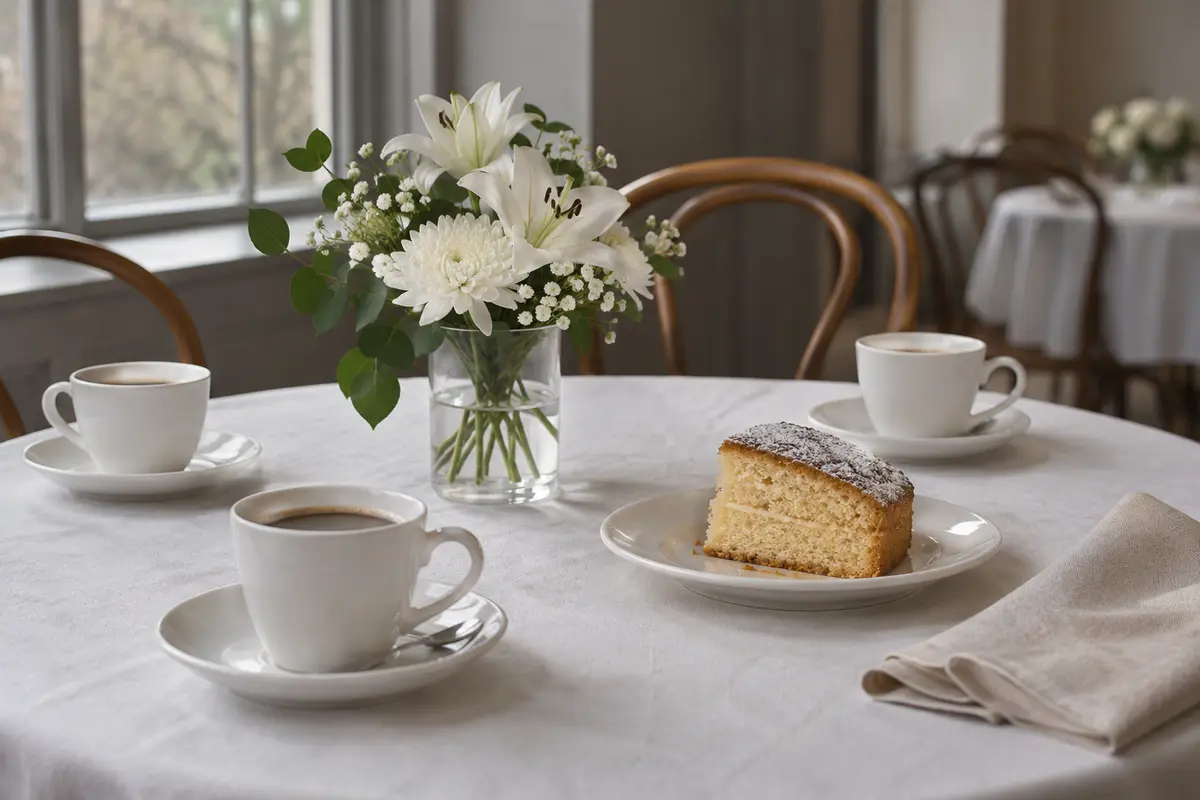
A funeral reception, repast or celebration of life almost never needs a full seating chart. In most cases it’s enough to reserve a quiet table for the immediate family, keep a few extra seats in reserve and let everyone else sit where they like.
The preparations fall into days when there is already a great deal to arrange. This guide isn’t meant to add to that. Take what helps you and leave the rest.
Do you need a seating plan at all?
That mostly depends on how people were invited and whether a sit-down meal with a fixed headcount is planned.
| Situation | What is usually enough |
|---|---|
| Open invitation announced at the service or in the obituary, buffet or light refreshments | a reserved family table, open seating for everyone else |
| Sit-down meal with RSVPs and a fixed headcount | a simple plan by table, without assigned seats |
| Several branches of the family, or strained relationships | one table per branch, all about the same distance from the immediate family |
Place cards for everyone rarely fit. Many guests come without letting you know, and some only stay briefly. For them in particular, it’s a relief to be able to simply join a table.
How many people will come?
Often you can only estimate. These points help:
- How the invitation went out: an open invitation in the obituary or from the pulpit is harder to predict than a personal invitation to a small circle.
- Ask people with experience: your funeral director and the venue, whether a church hall, restaurant or the funeral home’s reception room, have seen many similar gatherings. Ask for their estimate.
- Ask for a quick reply: if it feels right, name one family member people can let know they’re coming.
- A range instead of a number: give the venue a range, such as “between 30 and 45 people”, and ask whether tables can be added at short notice and how they charge, for example per person or by what is served.
What helps at the tables
- A set place for the family: one table, or one end of a long table, where the closest relatives sit together and don’t have to look for seats. A small “Reserved for family” sign is enough, handwritten is fine.
- Quiet, but easy to reach: the family table shouldn’t be right at the entrance, but guests should be able to get to it easily. Many want to offer condolences without squeezing past other tables.
- Older guests: seats close to the restrooms and exit, away from drafts, with room for a walker beside the chair.
- Children: if kids come along, a seat at the edge lets them get up without disturbing others.
- The pastor, priest or officiant: if they join the reception, a seat near the family is a kind gesture.
- Reserve: a few empty chairs along the wall or an extra table the venue can set up if needed.
What the venue will want to know
The venue usually doesn’t need a detailed seating list. What matters:
- the approximate number of people, or a range,
- the start time and how long the reception will last,
- whether you’re planning light refreshments, a buffet or a sit-down meal,
- any dietary restrictions in the family, such as gluten-free or dairy-free,
- where the family should sit and whether older guests need a particularly short walk.
For room size, the usual rules of thumb apply: about 20 to 24 inches of table edge per guest and enough space behind the chairs. More in our table spacing guide. The venue sets the maximum occupancy for the room.
If you do want to plan
For a sit-down meal with a fixed headcount, or when several branches of the family come together, a simple plan can ease tension and uncertainty. In the planner it takes only a few steps:
- Set up the room or start from the Long banquet tables or Small celebration template.
- Name the table for the immediate family “Family”. You’ll find the name field when you click the table.
- Add only the relatives who should have a set place and seat them at that table. Leave the other seats open.
- Keep the seating mode at Tables only, so nobody gets a seat number.
- Print the floor plan as a PDF for the venue. In US Letter, Tabloid, A4 and A3 it’s free, and you can attach the guest list if you like.
You don’t need an account. Without one, the plan stays on your device. If something changes at short notice, see handling last-minute changes.
FAQ
Who sits where at a funeral reception?
The immediate family sits together at one table or one end of a long table, somewhere quiet but easy to reach. Older guests get seats with short distances. Everyone else sits where they like.
Do you need place cards for a repast?
Usually not. A sign on the family table is enough. Place cards only make sense for a sit-down meal with RSVPs and assigned seating.
What if many more people come than expected?
Ask the venue beforehand whether tables can be added. A few reserve chairs along the edge take care of the first latecomers so nobody has to stand.